
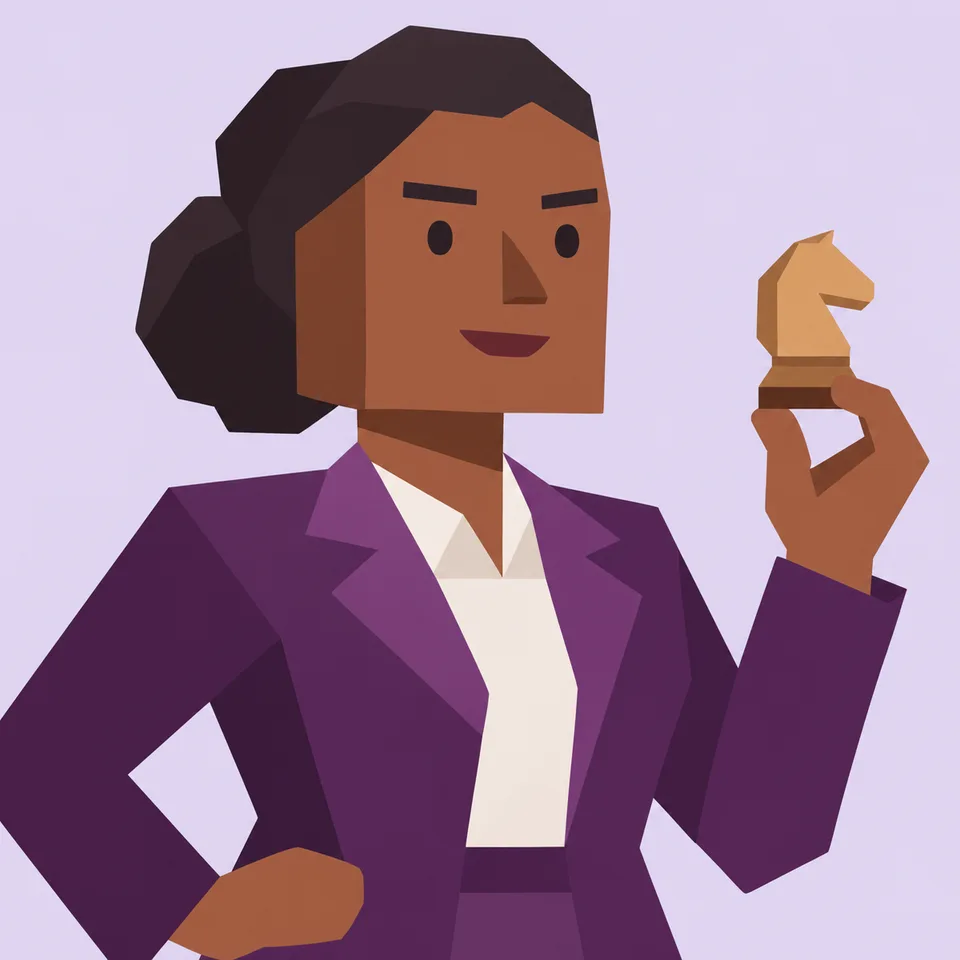
What the ENTJ personality is like
Somebody has to say what happens next, and more often than not it's you, a few seconds before anyone else noticed the question was open. A room without a plan feels like an unfinished sentence. You see the whole board: who is good at what, where it's stuck, what the next three moves are. You say it in plain words and people start moving. You're drawn to people and action, you live in ideas, you check what's true before you check what's kind, and you like a thing decided. That reads as Outgoing, Intuitive, Head and Planned. Here is how it looks from the inside.
How you move through a day
Your phone is a tool, not a room. Calls when it's urgent, voice notes when they're faster, and a group thread that has wandered gets one message from you with a decision at the end. You start the day with a list, and by ten it has been reordered by what actually matters.
In a meeting you're listening for what's holding the process up, and for the good idea buried under the loud one. You lean forward when it gets vague. "So who does what by Friday" is a question you ask kindly, because it's the one that moves things.
With friends you're the one who books the table, picks the time and says "I'll drive". Dinner without a plan is fine; you'll make one over dessert. Home runs like a workshop: what you need is where you left it, and what you don't is on its way out. Some nights you take a plan to bed, and at six it's still there, improved.
What you're good at
You turn a vague wish into a schedule. A team that has been circling for weeks gets a direction in one afternoon, and many of them feel relief, not pressure.
You decide. When a decision is stuck, you'll take it, name what it costs and own it. People who dislike deciding lean on that more than they say.
You say hard things early and straight, which spares everybody the long version.
And one you probably don't count: you notice potential. In a quiet junior, an odd idea, a half-built project, you see what it could become and you make room for it, sometimes before its owner believes it.
What it costs you
You move at the speed of your own picture. The plan arrived whole in your head, so the room meets it as an announcement. Some people needed ten minutes to get there and got a decision instead. You hear agreement, and part of it was catching up. You learn in week three what week one could have told you. It goes better when you ask what they see before you say what you'll do.
You check what's true before you check what's kind, and you're quick. A colleague hands you two weeks of work and you name what's wrong with it first, because that's the useful part. They carry that first sentence for a long time. Then they stop showing you drafts, and you see less.
Carrying it feels natural, so you do. Weekends go to the thing nobody else picked up, and the plan holds because you hold it. The price is rest, and the days when nobody thinks to ask whether you need a hand. It goes better when someone owns a piece outright, including the part they'll do differently.
Love and closeness
You move fast once you're sure, and you say so. You tell the person what you're looking for, you plan the second date at the end of the first, and you take their goals as seriously as your own.
You show love by taking things on: the trip booked, the awkward call made, the push to apply for the thing they doubted. A partner may want you to sit in the not-knowing with them, with no plan for it. Ten minutes of "that sounds hard" and no next step is a gift you can give.
You like a partner who argues back; agreement without friction feels thin. Alone time comes in short, planned doses, and it isn't an escape.
Friends
Plenty, and a few close ones. You're the one who gets people into the same room: the reunion, the trip, the group that wouldn't have happened without your message. Friends come to you for the straight read and the next step. You can lose a month to work and come back with a plan for the weekend. What slips is the unplanned check-in, the call with no agenda. What you're good for is the push: "send it" lands better from you, because you so clearly mean it.
Work and getting things done
You do your best work in a room with a goal, a clock and people you can move. Give you a team that needs direction, authority to change what's in the way and results you can see, and the week goes well. Give you a role that's all upkeep with no say, and you start redrawing the org chart in your head.
What drains you: slow decisions with no owner, meetings that end in "let's circle back", people who nod and don't do. What helps: clear ownership, pushback with reasons, a measure of progress.
Teams get the most from you when they tell you early where they disagree. You'll adjust, if the reason is good.
If you're close to one
Say the disagreement in the first minute, not the fifth; they'd rather have it plain. Bring a reason, and bring the feeling too. If they take over a task you meant to do yourself, that's usually care, said fast. Tell them out loud when you'd like to be heard and not fixed, and they'll mostly listen. A pause from them is a compliment: they're weighing what you said.
The two letters still to come
Two letters are still to come. One says how things reach you under pressure: Steady or Sensitive. The other says who you turn to when it's hard: people, which is Collaborative, or yourself, which is Self-reliant. The four Strategists differ more than you'd expect. And if one of your four letters landed in between, read the neighbor too; both are you.
Personality types one letter from ENTJ
- INTJThe Navigator
Same plan, quieter. The Navigator walks the route alone and shows the finished map; you think out loud and move people as it forms.
- ESTJThe Conductor
Same drive to organize. The Conductor works from what has been proven and tested; you're pulled toward what hasn't been tried yet.
- ENFJThe Guide
Same lead from the front. The Guide weighs how each person is doing before the route; you weigh the route and trust people to say.
- ENTPThe Spark
Same speed, same arguments. The Spark keeps options open for the joy of it; you close them so something can start.
 ENTJ-AC
 ENTJ-AS
 ENTJ-TC
 ENTJ-TS