The official MBTI questionnaire has 93 questions; free MBTI-style tests run from 8 to 72. The free formats we compared ran from 8 to 60 questions, and this test asks 72 statements, 12 per letter across six letters, in about 10 minutes. Count is only half the story: 12 five-point statements per letter gave the same letter back 78% of the time, while 15 yes/no questions managed 75%.
How many questions the official MBTI questionnaire has
The standard official questionnaire, MBTI Step I Form M, has 93 items and takes about 20 minutes, according to its publisher. The longer Step II Form Q has 144 items, the 93 of Form M plus more that break each letter into finer parts, and takes about 35 minutes. The publisher’s newer Global versions are one item shorter: 92 items for Step I and 143 for Step II.
We have not written a price, because we could not check one at the source. The rest of this post is about something else: free MBTI-style tests built from public research statements rather than the official questionnaire. Their lengths start much lower, which raises the question of how short a test can be and still give you the same letters back.
Two separate costs
A test spends your attention in two ways, how many statements each letter gets and how you answer them, and the two are priced separately.
The first is how many statements each letter gets. One statement about parties cannot tell a mild lean towards E from a strong one; twelve statements about different situations can.
The second is how you answer. A yes/no question keeps one bit: this side or that. A five-point scale, from “Very inaccurate” to “Very accurate”, keeps how far you lean. Throwing that away is like photographing a slope in black and white: you still see which way it goes, but not how steep it is.
The two costs are independent. A 60-question yes/no test pays the first and still pays the second.
Free MBTI questionnaire formats side by side
We checked this on 60,000 real answer sheets from Johnson’s public IPIP-NEO data. For each format we drew two non-overlapping sets of research statements, 40 times over, and counted how often the same person landed on the same side of each scale in both sets. Only the four MBTI letters are compared here, so the totals are for four letters.
| Questions (per letter) | Answer format | Same letter | All four the same |
|---|---|---|---|
| 8 (2) | five-point | 62% | 15% |
| 20 (5) | yes/no | 65% | 18% |
| 32 (8) | five-point | 74% | 31% |
| 48 (12) | yes/no | 73% | 28% |
| 60 (15) | yes/no | 75% | 32% |
| 48 (12) | five-point, random research statements | 78% | 38% |
| 48 (12), this test’s four MBTI letters | five-point, hand-picked | about 81% (estimated) | about 44% (estimated) |
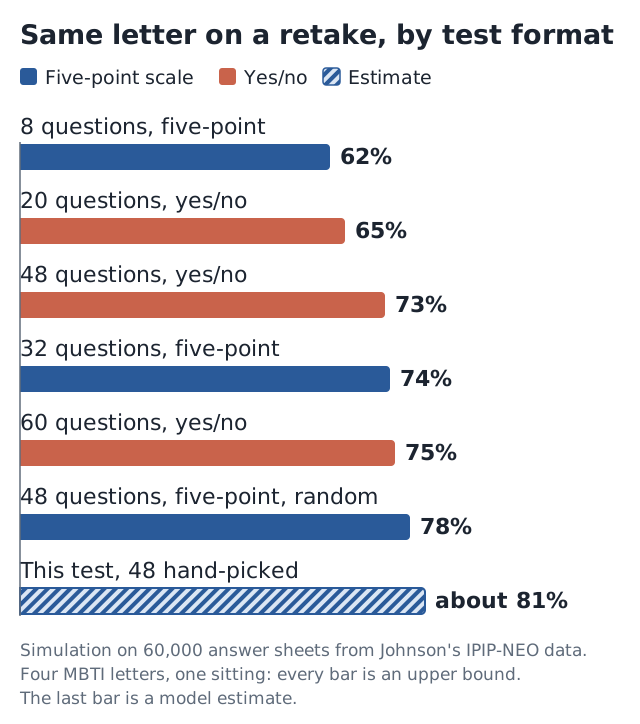
Read down the yes/no rows and the count does its job: 5, 12 and 15 questions per letter climb from 65% to 73% to 75%. Then compare the two 48-question rows. Same length, the same kind of research statements, and the five-point version beats yes/no by five points per letter and ten points on the whole type. Format bought what 12 extra yes/no questions could not.
How long an MBTI questionnaire needs to be
Eight statements per letter on a five-point scale already reach 74%, close to what 60 yes/no questions manage. Twelve per letter adds a few more points. Past that the gains get smaller.
The ceiling is set by where the line is drawn. A letter is the side of the middle you land on, and some people land close to it. For them, no number of extra statements settles the question, because there is not much to settle: they genuinely sit near the line, and on another day a few answers shift and so does the side. Piling on statements past that point makes everyone sit through more, and still mislabels the people near the line.
That is why this test does not keep piling on statements. It asks 12 per letter, then a few more only on the scales that came out close, and if a scale is still close the result says in between rather than forcing a side. Spending questions where the doubt is beats spending them everywhere.
Why 72 and not 48
The table says 48 for the four letters, and the test has 72 statements. Both are right. Twelve statements for each of the four MBTI letters make 48. This test adds two more letters, measured the same way: whether you stay steady or react under pressure (A or T), and whether you lean on others or handle things yourself (C or S). Two more letters at 12 statements each make 72, and six letters give 64 types such as INTJ-AC or ENFP-TS.
The four MBTI scales themselves line up with four traits from the Big Five, the most studied model of personality: E/I with extraversion, S/N with openness, T/F with agreeableness and J/P with conscientiousness (McCrae and Costa, 1989). Most statements here, 65 of the 72, come from the International Personality Item Pool, a public research collection started by Lewis R. Goldberg, which is what made a like-for-like comparison of formats possible. MBTI is a registered trademark of The Myers-Briggs Company, and this site is not affiliated with it.
How we measured
These figures come from a simulation and lean in a known direction.
- Both sets were answered in the same sitting, so every row is an upper bound. A real retake weeks later agrees less.
- Letters were split at the middle of each format’s own results. That flatters yes/no formats.
- The short formats were built from validated research statements. Many quiz sites write their own questions instead, so the short rows are kinder to them than reality.
The last row is a model estimate, not a measured figure. The same model reproduced the random-12 row within half a point (78.0% against 78.3% measured). Note also that per-letter figures multiply: even at about 81% per letter, fewer than half of people get all four letters back. What that means for a result that “changes” is covered in How accurate is an MBTI test?, and the sources are on the method page.
In short
Count questions, but count the answer format too. Two per letter is too few; 12 on a five-point scale is about where the gains get small; a yes/no test needs more questions to reach less. And a test that admits a close call is worth more than one that asks twice as much and forces a side.
Seventy-two statements, about 10 minutes, nothing to sign up for: take the test.
Questions about MBTI questionnaire length
Is the MBTI questionnaire on this site the official one?
No. This is an independent test, and 65 of its 72 statements come from the International Personality Item Pool, a public research collection. The official MBTI questionnaire is sold by The Myers-Briggs Company, and this site is not affiliated with it.
How long does a free MBTI questionnaire take?
Free MBTI-style tests run from 8 to 72 questions. This one asks 72 statements and takes about 10 minutes. Shorter ones are quicker but give the same letter back less often.
Does a longer test give a more accurate type?
Up to a point. In our simulation, going from 5 to 15 yes/no questions per letter raised agreement from 65% to 75%, and 8 five-point statements per letter already reached 74%. Past about 12 per letter the gains get small.
Why do yes/no questions need more items?
A yes/no answer keeps only which side you lean to, not how far. With 12 statements per letter, the five-point version gave the same letter back 78% of the time, against 73% for yes/no.
Why does this test ask more questions on some letters?
When a scale lands close to the middle, the test asks a few more statements on that scale only. If it is still close, the result says you are in between instead of forcing a side.
How many questions does this test ask in total?
72 statements, 12 for each of six letters, plus a few more on any scale that comes out close. The four MBTI letters use 48 of them; the other 24 measure how you handle pressure and whether you lean on others.